Mastering the Logic of Drawing Coordination and Callout Integrity
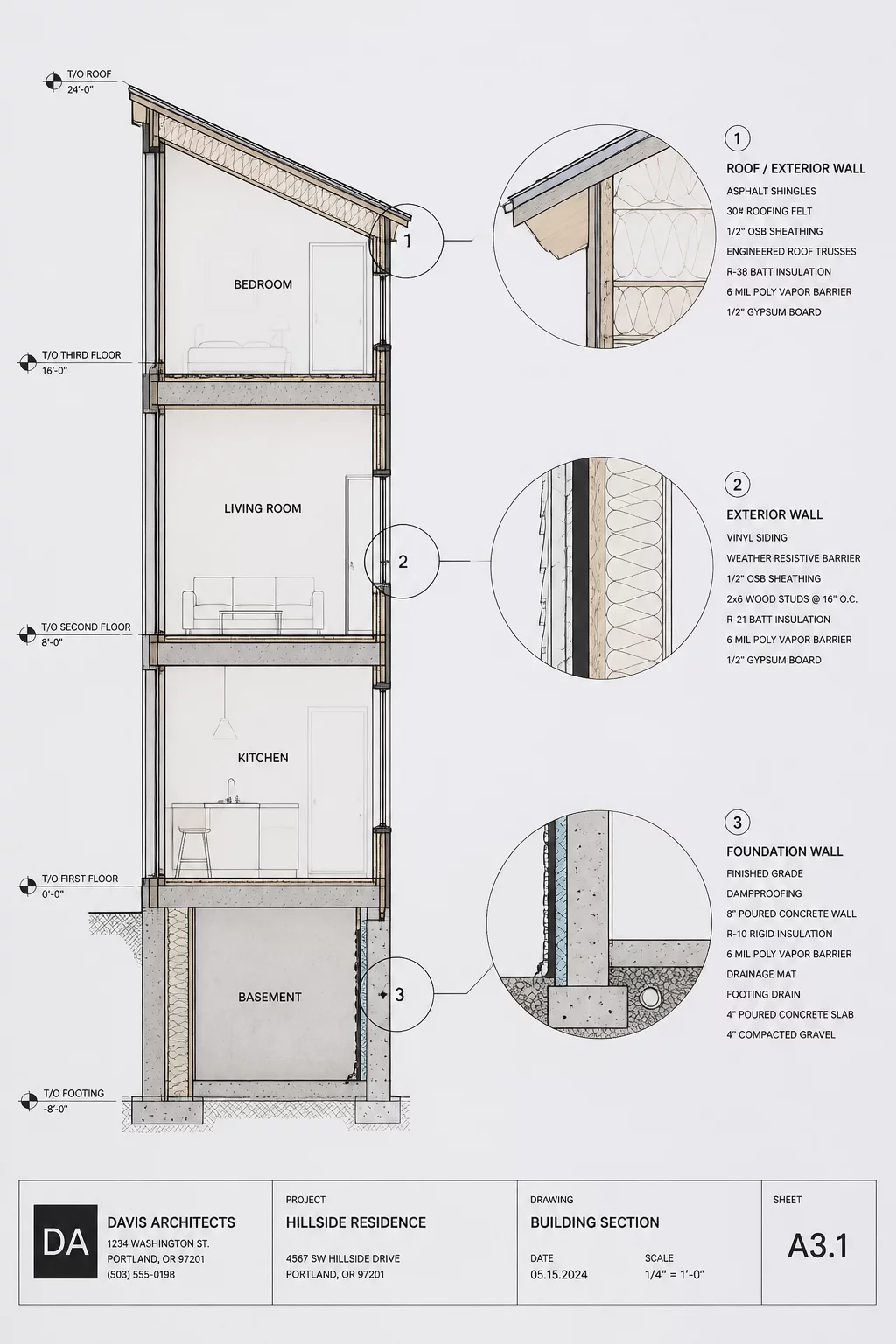
In the high-stakes environment of construction documentation, the integrity of a drawing set relies heavily on the accuracy of its cross-references. Section and detail callouts act as the connective tissue between broad floor plans and specific technical assemblies. When these references fail, the resulting confusion often leads to costly RFIs, construction delays, and field errors that could have been avoided during a thorough coordination review.
The Logic of the Callout Symbol
A standard callout typically consists of a bubble divided into two halves. The upper portion identifies the specific detail number, while the lower portion indicates the sheet where that detail is located. It sounds simple, yet the manual nature of coordinating these numbers remains a primary source of architectural friction. Reviewers must verify that every cut on a plan actually exists on the target sheet and that the orientation of the section arrow matches the perspective shown in the detail.
Common Coordination Pitfalls
- The Ghost Callout: A reference pointing to a detail that was deleted or moved to a different sheet during a late-stage revision.
- Scale Mismatches: The section cut implies a certain level of detail, but the resulting drawing is at a scale that obscures critical information.
- Inconsistent Labeling: Discrepancies between the title block name of the detail and the name used in the callout reference.
- Directional Errors: Section arrows pointing north while the drawn section clearly looks south, leading to mirrored installations.
Systematic Verification Protocol
A professional review involves more than just glancing at the bubbles. It requires a round-trip verification. Start at the plan, follow the callout to the detail sheet, confirm the detail exists and is accurate, then check the detail's own back-reference to ensure it points back to the correct parent plan. This closed-loop system ensures that any contractor or consultant navigating the set never hits a dead end.
"A drawing set is only as strong as its weakest link. A detail that cannot be found might as well not exist at all." — Robert Vance
Frequently Asked Questions
What is the most effective way to track callouts in a large set? Using digital markup tools like Bluebeam Revu allows you to create hyperlinked callouts, making the verification process significantly faster and reducing manual search errors.
Should callouts be placed on every sheet where an assembly appears? Not necessarily. Over-detailing can clutter a set. Focus on primary plans where the context of the assembly is most relevant to the trade performing the work.
Discussion & Feedback
No comments yet. Be the first to leave a comment.
Leave a Comment